

Attorney Fees for Closing in NY: The Complete Breakdown for Buyers and Sellers
What Should You Budget for Attorney Fees at a New York City Closing?
Attorney fees for closing in NY typically depend on transaction structure, property classification, and financing terms. Buyers and sellers retain independent counsel to manage custom contract riders, municipal violation searches, title exceptions, and escrow funds. Retainers are generally quoted as predictable flat rates covering representation from initial pre-contract review through settlement.
Before hiring an attorney, ask for a written quote that clearly defines what the retainer covers and what third-party disbursements are billed separately. In a Brooklyn cooperative purchase, for example, reviewing the corporation’s financials and proprietary lease requires significant diligence hours. In financed deals, bank counsel fees also appear on settlement statements as separate closing items.
New York practice relies on separate legal representation for buyers and sellers to protect their respective contractual and financial interests throughout the transaction lifecycle.
Why Do Buyers and Sellers Commonly Hire Attorneys for New York City Closings?
New York City property conveyances require properly executed and recorded instruments, and local practice calls for heavily negotiated contracts. Buyers and sellers hire independent real estate attorneys to negotiate contract terms and riders, examine municipal records, resolve title defects, manage down payment escrows, and coordinate lender closing instructions with the title company and bank counsel.

Statutory Guidelines and Real Property Law in New York
Residential transactions across the five boroughs typically start from a standard bar association form contract, then rely on extensive attorney-negotiated riders tailored to the property and the parties. Licensed real estate brokers may prepare non-binding deal sheets, but they cannot draft contracts of sale, construct custom riders, or give legal advice on contract terms, because doing so would be the unauthorized practice of law.
A standard residential transaction begins when the seller’s attorney circulates an unexecuted draft agreement. The buyer’s counsel conducts municipal due diligence by requesting certificate of occupancy records from the Department of Buildings, reviewing open housing maintenance violations through the Department of Housing Preservation and Development, and checking for landmarks or environmental encumbrances. When unresolved permits or unrecorded alterations appear, counsel drafts corrective escrow terms or seller remediation obligations before contract execution. Skipping these pre-contract verification steps can leave a purchaser legally responsible for inherited code violations or illegal basement conversions that cost tens of thousands of dollars to remediate.
Distinct Legal Roles: Buyer’s Counsel, Seller’s Counsel, and Bank Attorneys
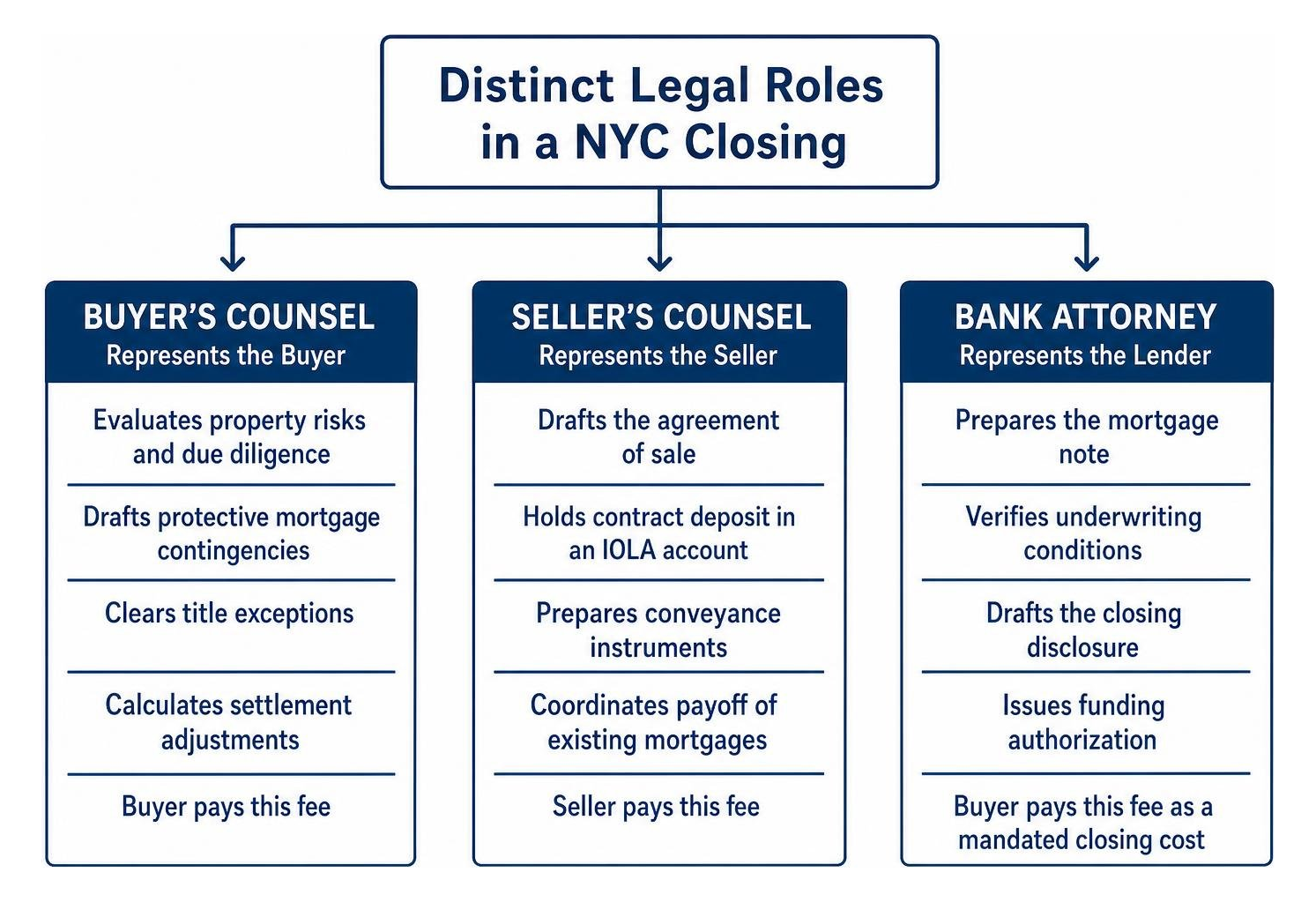
Each party to a New York City closing maintains distinct legal interests requiring dedicated representation. The buyer’s counsel evaluates physical and corporate property risks, drafts protective mortgage contingencies, clears title exceptions, and calculates settlement adjustments. The seller’s attorney prepares the contract of sale, holds the contract deposit in an Interest on Lawyer Account, prepares the deed or stock transfer documents, and obtains formal payoff documentation for outstanding mortgages.
Financed deals introduce institutional lender representation. Understanding what a real estate attorney does at a NYC closing helps distinguish individual advocacy from lender compliance. The bank’s closing attorney represents the mortgage institution alone, preparing the promissory note, verifying underwriting milestones, generating the closing disclosure, and issuing formal funding authorization. Mistaking the lender’s lawyer for an advocate of personal interests is a costly miscalculation because bank counsel will not review structural due diligence or negotiate seller concessions on behalf of the borrower.
How Much Do Closing Attorneys Charge in New York City for Different Property Types?
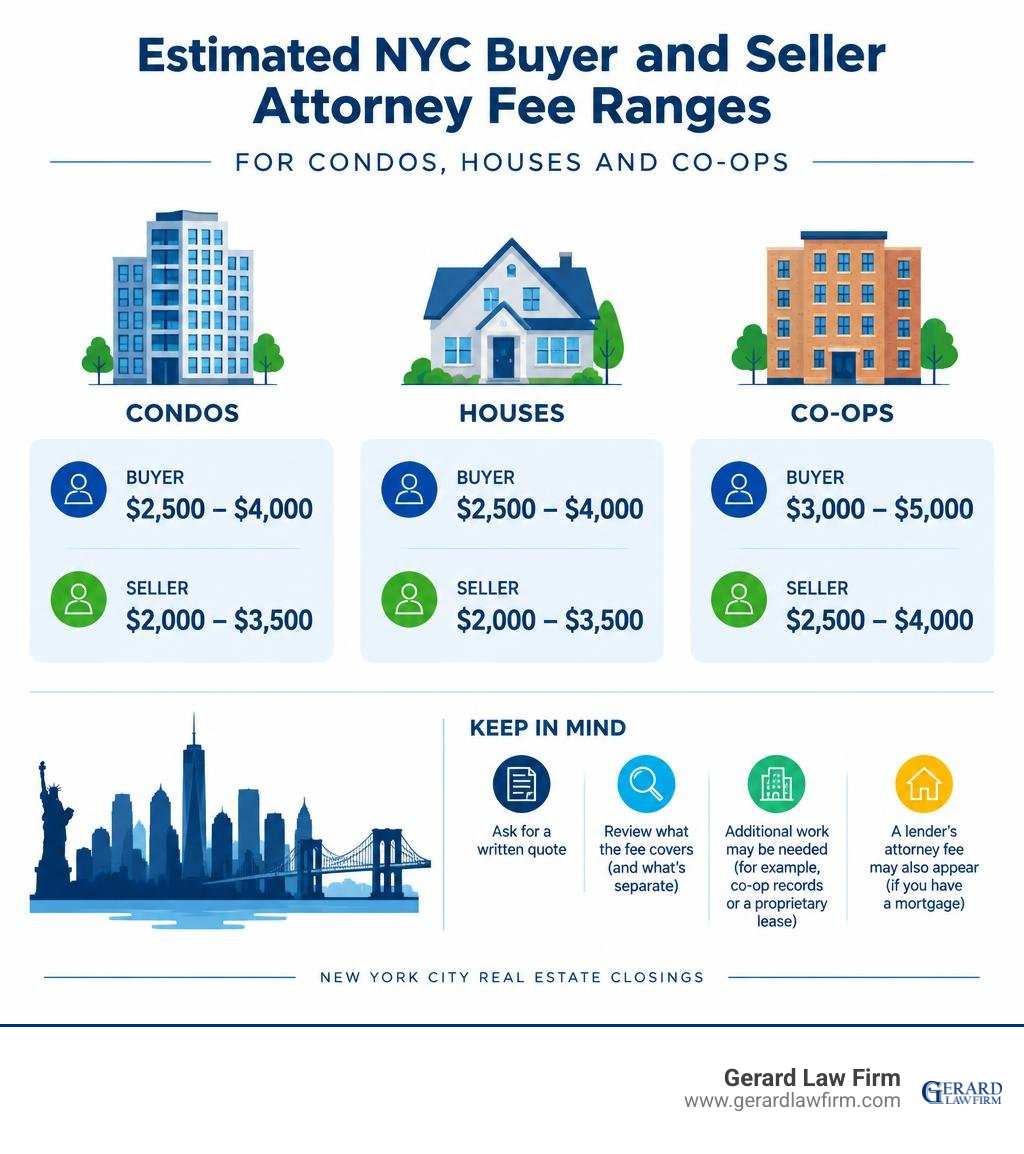
Closing attorney pricing in New York City reflects property type, ownership structure, and review complexity. Flat retainers vary between single-family homes, multi-family properties, condominiums, cooperative apartments, and sponsor new developments. Each transaction type introduces distinct legal obligations, corporate record examinations, board waiver protocols, and customized rider negotiations that determine the overall legal workload.
| Property Type & Location | Buyer Legal Fee Range | Seller Legal Fee Range | Key Work Drivers |
|---|---|---|---|
| NYC Single-Family / Townhouse | $2,500 – $4,000 | $2,000 – $3,500 | Title search review, municipal violations, boundary survey reading |
| NYC Condominium Unit | $2,500 – $4,000 | $2,000 – $3,500 | Common charge ledgers, unit title commitments, board waiver of right of first refusal |
| NYC Co-op Apartment | $3,000 – $5,000 | $2,500 – $4,000 | Minutes review, financial statements, proprietary lease, stock cancellation |
| NYC New Development | $3,000 – $5,000 | Sponsor’s counsel; buyer often pays the sponsor’s attorney fee | Offering plan analysis, sponsor rider negotiation, temporary certificates of occupancy |
Buyer Attorney Fees for Closing in NY by Property Structure
When hiring a New York residential real estate purchases attorney, legal scope shifts based on the ownership structure:
- Single-Family and Multi-Family Houses: Legal representation focuses on boundary surveys, metes-and-bounds legal descriptions, certificate of occupancy validity, real estate tax apportionments, and physical inspection reports.
- Condominium Units: Counsel reviews condo declaration bylaws, unit title insurance commitments, common charge payment ledgers, and coordinates the condominium board’s formal waiver of its right of first refusal.
- Cooperative Apartments: Because co-ops represent ownership shares in a corporation paired with a proprietary lease rather than real property deeds, representation requires analyzing corporate books and completing UCC lien searches.
- First-Time Homebuyer Purchases: Working with a New York first time home buyer attorney ensures clear guidance through mortgage contingency deadlines, statutory closing disclosures, and lender escrow accounts.
Failing to align the legal scope with the specific property structure creates major closing delays. For example, treating a co-op purchase like a conventional house purchase can result in missing board interview deadlines or overlooking sublet restrictions.
Seller Attorney Fees for Closing in NY: Standard Costs and Disbursements
Retaining a New York residential real estate sales attorney covers preparing the foundational contract, drafting protective seller riders, ordering payoff demands from existing mortgagees, and clearing title exceptions. Beyond base legal fees, seller closing disbursements include pass-through charges for courier deliveries, bank wire fees for loan payoffs, municipal record copy costs, and electronic recording platform surcharges.
Timing is essential for sellers. Delays in ordering payoff letters or resolving unrecorded satisfactions of previous mortgages can push the closing past the target date and the buyer’s rate-lock expiration, inviting renegotiation demands or, if the buyer properly makes time of the essence, putting the seller at risk of default.
Why Do Co-op Purchases and New Construction Require More Legal Review?

Cooperative and sponsor transactions demand extra attorney hours due to extensive document scrutiny. In a cooperative purchase, counsel examines years of board meeting minutes to uncover pending assessments, building-wide capital repair deficits, or shareholder litigation. Overlooking these minutes can saddle a buyer with surprise special assessments shortly after move-in.
New development purchases require counsel to dissect dense condominium offering plans and amendments submitted to the New York State Attorney General Real Estate Finance Bureau. Counsel examines sponsor budget projections, mechanics’ lien waivers, unit storage licenses, and the status of temporary certificates of occupancy to protect purchasers from unfinished building amenities or closing delays.
What Legal Services Are Included in Real Estate Closing Fees for Buyers and Sellers?
As defined in the attorney’s written engagement agreement, closing fees typically cover contract negotiation, down payment escrow management, title review, and settlement execution. Attorneys conduct pre-contract due diligence, draft customized contingencies, clear municipal violations, calculate closing adjustments, coordinate with institutional lenders, and submit mandatory conveyance filings to complete legal property transfer.
Pre-Contract Due Diligence, Board Package Reviews, and Offering Plans
Due diligence occurs before any contract is signed or deposit is submitted. For buyers, counsel orders judgment searches against the seller, inspects building reserve fund balances, examines underlying building mortgages, and analyzes alteration agreements to detect unauthorized renovations. In condo and co-op purchases, attorneys check whether scheduled capital assessments will increase monthly carrying costs.
When buying sponsor units, counsel evaluates commercial unit allocations, construction completion timelines, and tax abatement phase-out schedules. This prevents purchasers from inheriting unexpected shared operational liabilities or uninsurable unit conditions. Missing a pre-contract issue can significantly weaken the buyer’s leverage once the contract is signed and the down payment is deposited.
Contract Negotiation, Escrow Deposits, and Title Clearance
Understanding what is the contract of sale and how to negotiate it forms the foundation of attorney advocacy. The seller’s counsel drafts the agreement and deposits contract funds into a dedicated escrow account governed by statutory escrow rules. The buyer’s counsel negotiates protective contingency clauses covering mortgage commitments and, where the seller agrees, appraisal shortfalls. Because NYC buyers typically complete inspections before signing and most contracts are “as is,” structural concerns are usually handled through pre-contract due diligence, price adjustments, or negotiated credits rather than an inspection contingency.
Once contracts are fully executed, the buyer’s attorney orders a comprehensive title search and issues formal title objection letters. The seller’s attorney works to eliminate municipal violations, clear judgment liens, secure mortgage satisfaction pieces, and resolve estate tax claims prior to scheduling the closing date. An uncleared boundary encroachment or an unresolved probate title cloud can freeze the transaction indefinitely.
Closing Table Representation, Settlement Statements, and ACRIS Filings
At the closing table, retaining a contracts and closings lawyer ensures accurate financial reconciliation across all parties. Counsel inspects the title closer’s marked-up title policy, calculates per diem real estate tax and common charge adjustments, confirms utility credits, and oversees the delivery of certified bank checks.
Following execution, attorneys finalize recording documentation through the New York City Department of Finance Automated City Register Information System (ACRIS). This includes preparing and filing the Combined Real Estate Transfer Tax Return (Form TP-584) and Real Property Transfer Report (Form RP-5217). Filing mistakes or delayed submissions on ACRIS can trigger statutory tax penalties and block clean chain-of-title recording.
How Do Legal Fees Compare With Other Major New York City Closing Costs?
New York City property transactions involve substantial taxes and municipal fees that often exceed legal retainers. The mortgage recording tax is imposed under Tax Law Article 11, the state transfer tax and mansion tax under Tax Law Article 31, and the NYC Real Property Transfer Tax under the NYC Administrative Code. While attorney fees provide custom representation, buyers and sellers must also budget for title insurance and institutional bank attorney fees.
| Closing Expense Category | Responsible Party | Standard Rate or Description |
|---|---|---|
| Buyer Legal Retainer | Buyer | Custom flat fee based on property type |
| Seller Legal Retainer | Seller | Custom flat fee based on conveyance complexity |
| Bank Closing Attorney Fee | Buyer | $750 to $1,500 institutional fee |
| NYC Mortgage Recording Tax | Buyer | 1.80% (under $500k loan) or 1.925% ($500k+ loan) |
| NYS Mansion Tax | Buyer | 1.00% ($1M+); in NYC only, progressive tiers scale to 3.90% ($25M+) |
| NYS Transfer Tax | Seller (buyer in most new development sales) | 0.40% (under $3M) or 0.65% ($3M+ in NYC) |
| NYC Real Property Transfer Tax | Seller (buyer in most new development sales) | 1.00% (under $500k) or 1.425% ($500k+) |
Mortgage Recording Taxes, CEMA Assignments, and Bank Attorney Charges
Buyers financing real property purchases face mortgage recording taxes under state mortgage tax statutes, though cooperative apartment loans remain exempt because they finance corporate shares rather than real estate deeds. The lending institution covers a statutory 0.25% share of the overall tax rate.
To reduce this liability on residential real property, buyer’s counsel can request a Consolidation, Extension, and Modification Agreement (CEMA). In a purchase CEMA, the seller’s lender assigns the existing mortgage to the buyer’s lender, which consolidates it with the new loan, so the buyer pays recording tax only on the new money. A CEMA requires cooperation from both lenders, the seller often charges a fee to participate, and cooperative apartments are not eligible. A misstep in timing or missing original loan documents from the seller’s lender can cause a CEMA to collapse, forcing the buyer to pay the full recording tax at closing.
New York State Transfer Taxes, NYC RPTT, and Mansion Tax Thresholds
Sellers customarily pay the state and city conveyance taxes at closing. The New York State transfer tax applies to residential conveyances, alongside the NYC Real Property Transfer Tax (RPTT) based on sale valuation. In sponsor sales of new development units, however, the contract typically shifts both transfer taxes, and often the sponsor’s attorney fee, to the buyer, so new development purchasers should budget for them.
Buyers purchasing residential properties priced at $1,000,000 or higher must pay the New York State mansion tax. Outside New York City the rate is a flat 1%; in New York City, supplemental tiers raise the combined rate progressively for purchases of $2,000,000 or more, up to 3.9% at $25,000,000 and above. In cooperative buildings, sellers may also face a proprietary flip tax, calculated as a flat fee, a percentage of gross proceeds, or a percentage of net capital gain as established by building bylaws. Failing to budget for transfer taxes or flip tax calculations can leave a seller short of net payoff funds at settlement.
How Do NYC Closing Practices Affect Legal Expenses?
Closing customs across the five boroughs require hands-on management that influences legal work. Property files in historic Brooklyn brownstones or Manhattan pre-war cooperatives often contain complex chains of title, unrecorded heirship claims, or obsolete restrictive covenants that require curative title affidavits.
Scheduling a closing also requires coordinating the buyer’s counsel, seller’s counsel, title closer, payoff lender attorney, originating bank counsel, and managing agent. This procedural oversight ensures that funds clear and title insurance policies are delivered without title defects.
How Can Buyers and Sellers Manage Legal Expenses and Understand Closing-Cost Tax Treatment?
Under federal tax rules, many residential closing costs, including legal fees tied to the purchase, are generally added to the property’s cost basis rather than deducted, although some items, such as prepaid property taxes and certain mortgage points, are treated differently. Buyers and sellers manage legal expenses by negotiating clear flat-fee retainers, identifying pass-through disbursements in advance, and requesting seller credits to offset settlement transaction expenses.
Evaluating Flat-Fee Structures Versus Hourly Retainers
Most residential closing attorneys in New York City provide flat-fee retainers for standard purchase and sale transactions. A transparent flat-fee agreement covers pre-contract due diligence, contract negotiation, title clearance, lender coordination, and closing attendance.
Parties should review retainer terms to identify potential triggers for supplemental billing:
- Post-Closing Escrow Agreements: Administering repair or possession escrows after closing can incur supplementary administrative charges.
- Complex Title Curative Work: Resolving ancient mortgages, boundary discrepancies, or estate proceedings may require separate hourly billing.
- Financing Extensions and Adjournments: Multiple closing adjournments beyond standard target dates or repeated mortgage contingency extensions can lead to added fees.
- Third-Party Disbursements: Title search fees, ACRIS e-filing surcharges, and municipal document copy fees pass directly to the client as itemized costs.
Understanding these exceptions upfront prevents surprise fee disputes near the closing date.
What Do Buyers and Sellers Need to Know About Closing Costs and Tax Basis?
Legal fees related to buying residential real estate are capitalized and added to the buyer’s adjusted cost basis, reducing taxable capital gains when the property is sold in the future. Routine operational charges and mortgage application fees, by contrast, cannot be added to acquisition basis.
For sellers, closing legal fees, transfer taxes, and recorded title expenses reduce the net amount realized from the sale. Buyers and sellers should preserve final settlement statements, canceled checks, and closing disclosures in permanent records to support tax basis calculations with an accountant. Losing these records can make it harder to prove basis on a future resale, which matters most when a gain could exceed the Section 121 exclusion for a primary residence ($250,000 for single filers, $500,000 for married couples filing jointly).
What Should Buyers and Sellers Do Next?
Buyers and sellers preparing for a New York City real estate transaction should retain independent counsel immediately upon offer acceptance. Securing transparent legal representation before signing a binder (which is typically non-binding in New York) or circulating contracts protects deposits, clarifies fee structures, and ensures comprehensive pre-contract municipal and building due diligence across the transaction.
Transparent communication and defined fee schedules prevent unexpected billing during complex transactions. In Brooklyn and across the five boroughs, managing municipal searches, board requirements, and lender documents requires steady attorney oversight. Choosing a firm with direct attorney handling and structured digital file management helps keep transaction milestones on schedule.
Before executing transactional documents, consult a New York residential real estate attorney to review the purchase or sale terms, examine property records, and confirm a flat-fee representation agreement.
What Else Should Buyers and Sellers Know About Closing Legal Fees in New York?
When Should I Retain a Closing Attorney?
A buyer or seller should retain an attorney as soon as an offer is accepted and a transaction term sheet is distributed. Engaging counsel before contracts are circulated ensures that building due diligence, municipal violation reviews, and custom rider terms are completed before contractual deposits are committed.
Do Both Parties Use the Same Closing Attorney?
No. Representing both the buyer and the seller in the same New York real estate transaction is almost never appropriate and is strongly discouraged by New York ethics guidance, because the parties’ interests directly conflict on price, contract terms, and title issues. Each party should retain independent legal counsel to advocate for their respective contractual, financial, and title protections.
What Happens to Legal Fees if the Transaction Does Not Close?
If a transaction falls through prior to closing due to failed due diligence, title defects, or mortgage denial, the retainer agreement dictates fee handling. New York ethics rules prohibit nonrefundable retainer fees, so a well-drafted agreement typically provides for a reasonable minimum fee covering work already performed, such as due diligence and contract negotiation, and explains in plain language when that fee is earned and how it is calculated. The remaining balance allocated to closing table attendance is usually not charged.
Are Real Estate Attorney Fees Regulated by New York State Law?
New York State does not set statutory caps on residential real estate attorney fees. Legal fees are established by market conditions and written engagement contracts, subject to the general ethical standard under New York Rules of Professional Conduct that attorney fees must be reasonable.
How Does a Target Closing Date Differ From a Time of the Essence Closing?
Standard residential contracts in New York set an “on or about” target closing date. When time is not of the essence, either party is generally entitled to a reasonable adjournment; roughly 30 days is a common rule of thumb, not a legal standard. A firm deadline exists only if the contract contains an explicit “time is of the essence” clause or a party later serves a proper time-of-the-essence notice, which must be clear and unequivocal, set a reasonable new closing date, and warn that failure to close on that date will be treated as a default.