

Master the New York First-Time Buyer Process from Offer to Closing
How Does the New York First-Time Buyer Process Work from Offer to Closing?
A New York first-time home buyer begins by submitting an offer, but the deal remains non-binding until both parties sign a negotiated contract of sale and the buyer deposits escrow funds. The purchaser then completes mortgage underwriting, orders title or lien searches, submits a board application for a co-op or a right-of-first-refusal waiver package for a condo, attends a final walkthrough, and finishes the property closing.
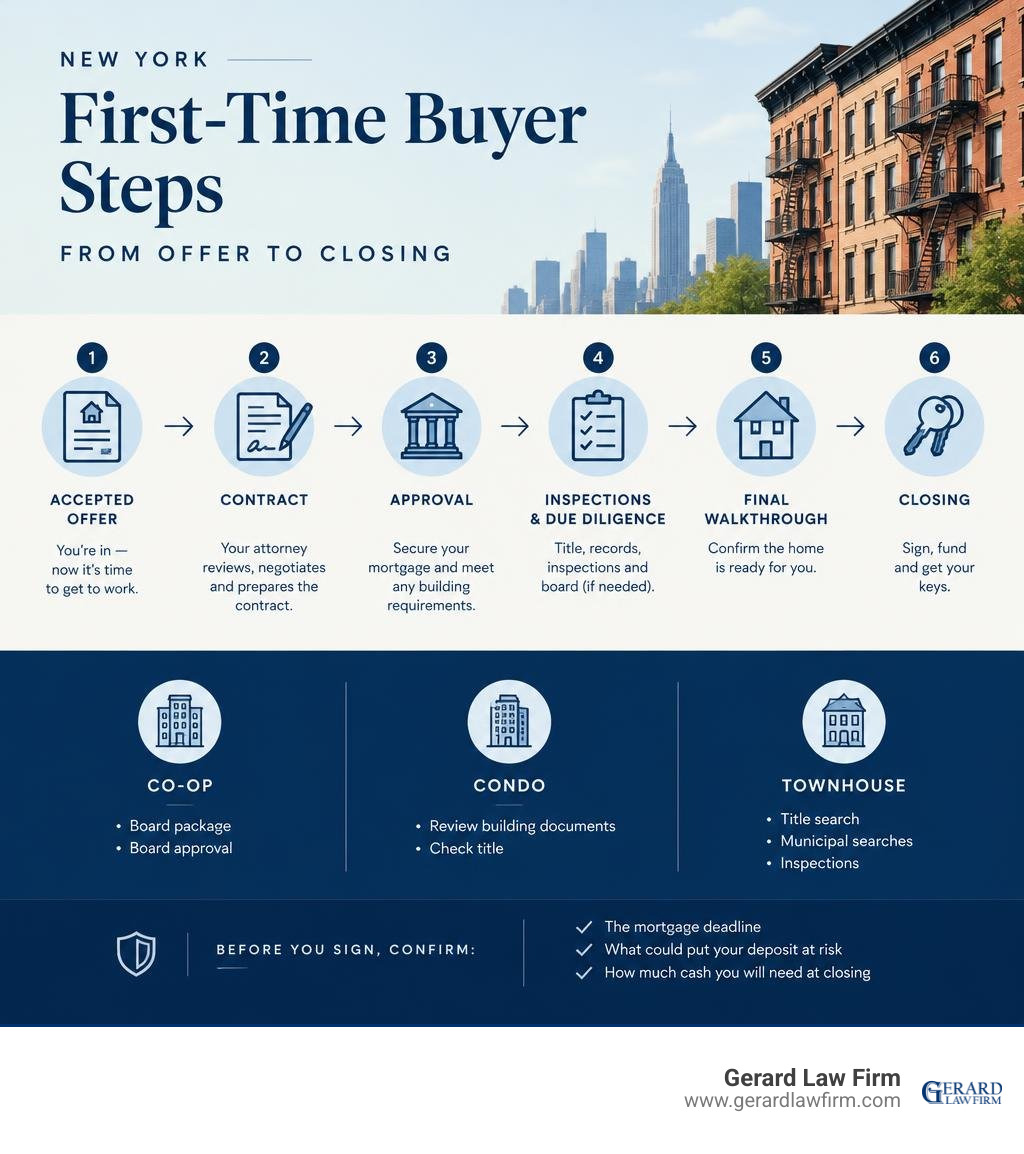
In New York City, an accepted offer is merely an informal consensus on purchase price and basic deal points. Because either side may walk away without penalty before contract execution, sellers may continue showing the property and can accept higher bids from competing purchasers. Moving through legal due diligence and contract negotiation without delay helps protect your position and limits transaction risk.
Once you sign the contract and deliver your deposit, and the seller countersigns and returns a fully executed copy, the operational period begins. Financed residential purchases in New York City typically take 60 to 90 days from contract to closing, and co-op board review or complex mortgage underwriting can extend the schedule further. Buyers must satisfy financing contingencies, municipal record reviews, and property assessments in orderly sequence to avoid breaching scheduled milestone dates.
The underlying property structure defines each procedural requirement along the timeline. Purchasing a single-family townhouse in Brooklyn typically involves municipal department searches, a survey, and a structural inspection. Acquiring a cooperative apartment involves reviewing building financial statements, board meeting records, and corporate proprietary leases. Condominium purchases center on reviewing original offering plans, amendments, and managing agent questionnaires. Managing these diverse pathways requires methodical attention to each phase through final funding.
What Down Payment Assistance May Be Available to a New York City First-Time Buyer?
Eligible New York City buyers may qualify for municipal or state down payment assistance programs offering forgivable loans or low-interest financing. Under New York Private Housing Finance Law Article XI, qualified purchasers can also access affordable units through Housing Development Fund Corporation cooperatives, provided they satisfy established income caps and owner-occupancy terms.
Securing municipal or state assistance requires early planning because public programs enforce strict procedural rules, so buyers should begin working with an approved housing counseling agency before going into contract. In New York City, municipal assistance is often paired with conventional mortgages, but primary lenders must formally approve the subordinate lien structure. Introducing an assistance program late in contract negotiations risks closing delays that could endanger down payment funds.
Buyers can explore city-backed options like the HomeFirst Down Payment Assistance Program – HPD, which provides financial support for primary residence purchases across the five boroughs. Program availability depends on municipal budget allocations and administrative schedules, which cause funding capacity to change throughout the calendar year.
What Eligibility Rules May Apply to First-Time Buyers?
Eligibility criteria for municipal and state programs follow specific administrative and statutory standards:
- First-Time Buyer Definition: Applicants generally must not have held an ownership interest in a primary residential property within the preceding three years, subject to limited exceptions under the HUD definition, such as for certain displaced homemakers and single parents.
- Household Income Thresholds: Qualifying limits are tied to Area Median Income (AMI) and adjust by household size. HomeFirst currently caps household income at 120% of AMI, and the same NYC AMI figures apply across all five boroughs.
- Minimum Personal Investment: Borrowers must contribute some of their own savings. HomeFirst, for example, requires a minimum down payment or contract deposit of at least 3% of the purchase price from the buyer’s own funds.
- Credit Profile and Underwriting: Buyers must obtain a formal mortgage pre-approval through an approved participating lender while meeting standard debt-to-income limits.
- Mandatory Education Certification: Buyers must complete a homebuyer education course with an HPD-approved counseling agency and receive an HPD Homebuyer Certificate. Finishing the course early, before going into contract, helps avoid delays.
What Terms and Forgiveness Conditions Should Buyers Check?
Assistance funds are typically structured as subordinate deferred-payment junior mortgages placed against the property. These instruments impose ongoing compliance rules across multi-year terms.
The principal condition mandates continuous primary residence occupancy. Under HomeFirst, the loan is forgivable after 10 years for loans of $40,000 or less and after 15 years for larger loans, and City-funded loans carry a 15-year term regardless of amount. Selling, renting out, or refinancing before the term ends can trigger repayment, so buyers should review the recapture terms in their loan documents with counsel.
What Other Assistance or Limited-Equity Co-Op Options Should Buyers Explore?
State mortgage agencies provide low-interest financing paired with down payment assistance loans. These programs allow eligible purchasers to finance acquisition expenses with modest initial out-of-pocket costs.
Another pathway, found mostly in Manhattan, the Bronx, and Brooklyn, is acquiring an apartment within an HDFC cooperative:
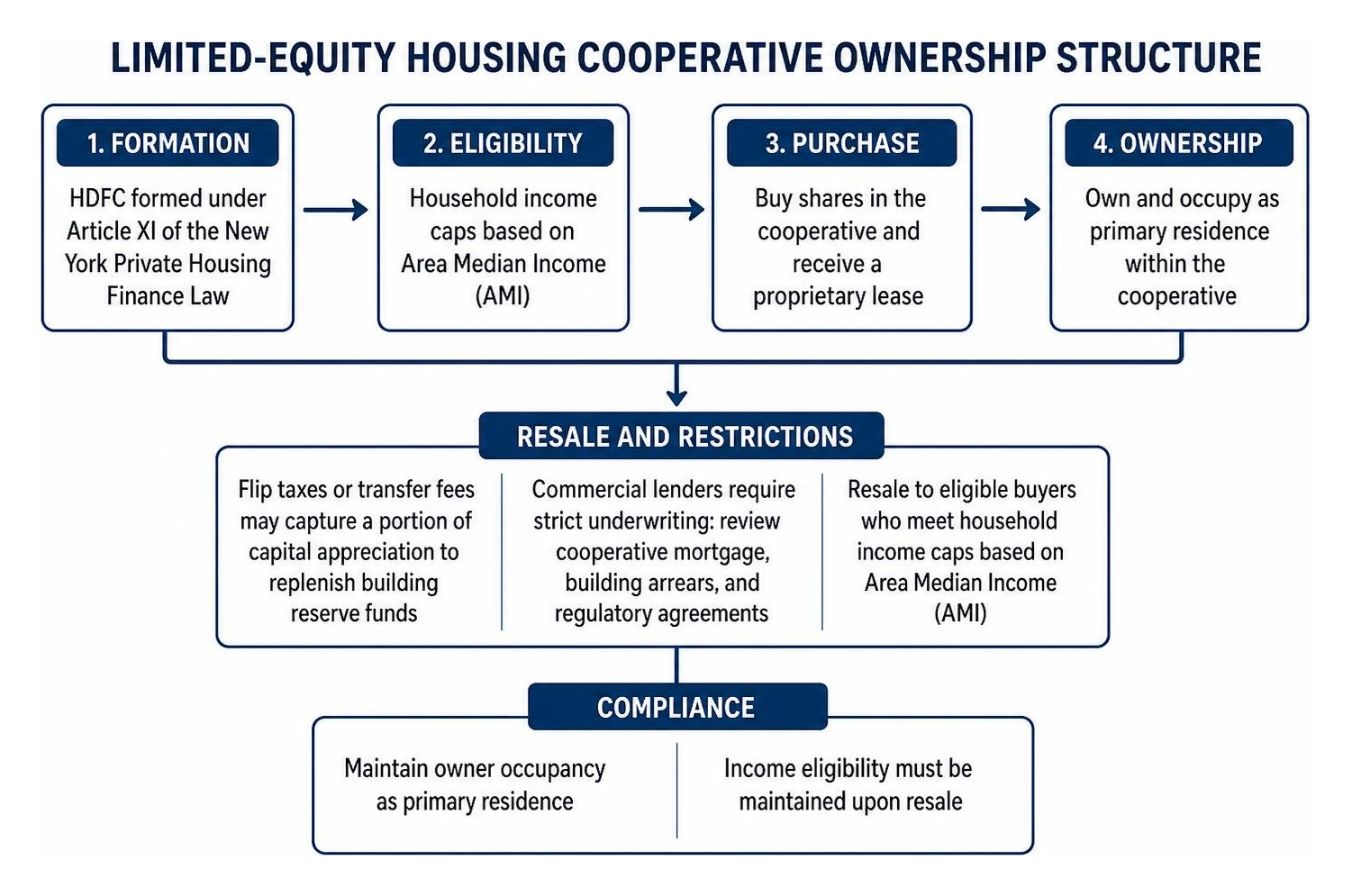
HDFC purchases require careful legal review. Although sale prices are lower than market-rate housing, HDFC buildings typically impose purchaser income caps, may restrict resale prices, and frequently levy substantial flip taxes on resale to support capital reserves. Mortgage lenders enforce strict underwriting rules on these corporations, requiring close examination of building finances, municipal regulatory agreements, and reserve accounts.
How Do Co-Op and Condo Purchases Differ for NYC First-Time Buyers?
A condominium buyer purchases fee simple real property conveyed by a deed under New York Real Property Law Article 9-B. In contrast, a cooperative buyer acquires personal property shares in a housing corporation paired with a proprietary lease granting occupancy rights, requiring extensive corporate due diligence and mandatory board review.

Understanding structural differences between property types helps buyers evaluate risk. Condominium ownership conveys title to an individual airspace parcel alongside an undivided common element interest. In Manhattan, the Bronx, Brooklyn, and Queens, deeds are recorded with the Office of the City Register and searchable in the Automated City Register Information System (ACRIS); Staten Island deeds are recorded with the Richmond County Clerk. Working with a New York residential real estate purchases attorney helps protect title conveyance and contract terms across either ownership form.
Cooperative apartments involve purchasing corporate shares rather than real estate. The corporation owns the land and structure, and the buyer receives a long-term proprietary lease. Because the board oversees corporate operations, prospective buyers must satisfy distinct admissions criteria.
What Co-Op Due Diligence, Board Approval, and Financial Requirements Should Buyers Expect?
Cooperative boards have broad discretion to approve or reject applicants, limited by fair housing and anti-discrimination laws, and courts generally defer to their decisions under the business judgment rule. Most boards apply strict financial guidelines:
- Debt-to-Income Standards: Boards frequently cap debt-to-income ratios between 25% and 28% of gross monthly earnings, factoring in housing maintenance, mortgage payments, and personal debts.
- Post-Closing Liquidity: Corporations often mandate that buyers maintain 12 to 24 months of total carrying costs in liquid reserve funds following closing.
- Board Package and Interview: Applicants submit detailed tax returns, asset verifications, and reference letters, concluding with a formal board interview.
- Sublet Restrictions: Co-op proprietary leases and house rules often restrict or ban subletting, limiting rental flexibility for future owners.
- Corporate Financial Review: Counsel examines audited financial statements, underlying building debt, reserve balances, and meeting minutes to verify corporate solvency.
What Condo Offering Plan, Closing Costs, and Rights of First Refusal Should Buyers Review?
Condominiums offer greater subletting flexibility and streamlined purchase procedures, though acquisition costs are typically higher.
The governing document is the Offering Plan, filed with the Real Estate Finance Bureau of the New York State Attorney General’s Office. Counsel examines the plan and subsequent amendments to confirm sponsor disclosures, capital repair plans, and reserve funds.
Most New York City condominium bylaws give the board a right of first refusal, enabling it to buy the unit on the same contract terms. Boards routinely waive this right by issuing a written waiver certificate required at closing. Managing agent questionnaires confirm owner-occupancy rates and any common charge delinquency across the building.
What Are the Key Legal Steps from Offer to Closing in New York?
After offer acceptance, parties negotiate contract terms, complete property due diligence, execute agreements, deposit escrow funds, secure mortgage commitments, and obtain title clearance. The contract down payment is typically held by the seller’s attorney as escrow agent in an attorney trust account, governed by the contract’s escrow terms and Rule 1.15 of the New York Rules of Professional Conduct, until closing or resolution of any dispute.
A transaction advances through distinct legal stages that convert an accepted bid into final ownership. Buyers can review standard transaction milestones when preparing for the ten steps to homeownership.
Failing to observe contractual timelines creates significant default risks. A buyer who misses the mortgage contingency deadline can lose the protection of that contingency, and failing to meet other contract obligations, such as submitting a timely board application, can expose the buyer to default claims.
What Should an Attorney Review During Due Diligence and a Title Search?
Before contract execution, legal counsel reviews building records to identify physical, financial, or regulatory concerns. For apartment buildings, this includes reviewing board meeting minutes to uncover discussions regarding recurring leaks, facade repairs, or pending assessments.
For condominiums and houses, counsel reviews public property records. Completing a detailed title search process and defect detection confirms clear title, identifies unsatisfied liens, verifies real estate taxes, and checks Department of Buildings or Housing Preservation and Development records for open building code violations or certificate of occupancy issues.
What Contract Protections Should a New York First-Time Buyer Discuss With an Attorney?
New York residential contracts incorporate tailored contract riders to safeguard buyer deposits:
- Mortgage Contingency Clause: Protects down payment funds if a qualified institutional lender declines a timely, good-faith loan application.
- Appraisal Provisions: If negotiated, an appraisal contingency establishes remedies if an independent appraisal falls below the agreed purchase price, determining whether parties renegotiate or cancel. Most NYC contracts do not include one by default.
- Closing Date Terms: Contracts commonly specify an “on or about” closing date, which under New York law entitles either party to a reasonable adjournment. What counts as reasonable depends on the circumstances and the contract terms.
- Time of the Essence Notice: If an opposing party fails to close after a reasonable adjournment, counsel may issue a formal notice setting a final mandatory closing deadline. The notice must be clear and unequivocal, give a reasonable time to perform, and come from a party ready, willing, and able to close.
These terms require careful customization when negotiating the New York contract of sale.
How Are the Escrow Deposit and Mortgage Contingency Deadlines Managed?
At contract signing, the purchaser deposits contract funds, typically 10% of the purchase price, into the seller’s attorney’s escrow account. Under standard contract terms, the escrow agent releases these funds at closing, on joint written instructions from both parties, or, if a dispute arises, through the notice procedures in the contract or by court order.
Standard mortgage contingencies allow 30 to 45 calendar days to secure an institutional loan commitment letter. If the lender issues a decline letter or adds unfulfillable conditions, counsel must send formal written notice to cancel the contract before the contingency deadline expires. Retaining a dedicated contracts and closings lawyer helps keep contractual notices and escrow conditions on track.
What NYC Closing Costs and Taxes Should Buyers Budget For?
New York City buyers must budget for recording fees, title insurance, lender charges, adjustments, and statutory taxes. Under New York Tax Law Article 11, mortgage recording taxes apply to real property loans, while New York Tax Law Section 1402-a imposes the additional transfer tax known as the mansion tax, paid by the buyer, on residential purchases of $1,000,000 or more.

A complete closing budget accounts for recording charges, bank fees, and building adjustments. In resales, the seller customarily pays the New York State and New York City transfer taxes, but buyers often pay them in sponsor (new-development) sales, as outlined in our complete legal guide for residential sales in 2026.
| Expense Category | Condominium / Real Property | Cooperative Housing Corporation |
|---|---|---|
| NYS / NYC Mortgage Recording Tax | Applicable on loan amount | Exempt (shares are personal property) |
| Title Insurance Policy | Lender’s policy required with a mortgage; owner’s policy optional but strongly recommended | No standard title policy; optional co-op (UCC) insurance policy available |
| NYS Mansion Tax | Applicable on purchase price ≥ $1,000,000 | Applicable on purchase price ≥ $1,000,000 |
| UCC Financing Statement (UCC-1) | Not applicable | City Register filing fee applies |
| Municipal Search Fees | Full title & municipal search packet | Cooperative lien & judgment search |
| Managing Agent / Board Fees | Move-in deposits & questionnaire fees | Transfer agent, questionnaire, & move fees |
What Mortgage Recording and Mansion Taxes May Apply?
Taxes represent a substantial portion of closing settlement charges:
The Mortgage Recording Tax applies to loan amounts secured by real property mortgages on condominiums and townhouses. In New York City, the total tax on one- to three-family homes and individual condominium units is 2.05% of the loan amount for mortgages under $500,000 and 2.175% for mortgages of $500,000 or more. Institutional lenders pay 0.25% of that total, so the borrower typically pays 1.80% or 1.925%. Cooperative loans remain exempt because co-op financing is secured by personal property shares.
The state Mansion Tax applies to residential transfers where consideration reaches or exceeds $1,000,000. Rates start at 1.00% of the entire purchase price between $1,000,000 and $1,999,999. Outside New York City the rate stays at 1%, but in New York City it scales across tiered statutory brackets up to 3.90% for conveyances of $25,000,000 or more.
What Legal Fees, Title Insurance, and Building Settlement Charges Should Buyers Expect?
Buyers must also prepare for title, lender, and building settlement fees:
- Title Insurance Premiums: Fee and loan title policy rates are set by the Title Insurance Rate Service Association and approved by state regulators.
- Bank Attorney and Underwriting Fees: Borrowers cover lender legal fees, appraisal costs, underwriting charges, and tax escrow reserves.
- Managing Agent Charges: Buildings charge fees for application processing, questionnaires, and move-in coordination.
- Prorations and Adjustments: Closing adjustments account for real estate taxes, common charges, and maintenance fees, balancing all legal responsibilities handled at an NYC closing.
What Common Mistakes Should First-Time Homebuyers Avoid in New York City?
First-time buyers frequently risk financial loss by overlooking building reserve deficits, miscalculating required post-closing liquidity, confusing preliminary pre-qualifications with formal loan commitments, and missing contractual contingency deadlines. Conducting thorough pre-contract due diligence, reviewing building financial statements, and coordinating closing schedules with legal counsel help mitigate these common transaction pitfalls.
Entering the residential market without professional support can result in forfeited down payments or unexpected building costs. Working with an experienced New York residential real estate attorney helps buyers avoid mistakes such as skipping a pre-contract inspection, misjudging escrow requirements, or signing contracts and riders without review.
How Can Buyers Assess Building Finances and Pending Assessments?
Purchasers must evaluate whether a cooperative or condominium faces underlying physical deficits or operating shortfalls:
- Operating Deficits: Consecutive years of negative operating cash flow suggest that monthly maintenance charges or common fees may rise significantly.
- Reserve Fund Underfunding: Insufficient reserve balances leave communities unable to fund major boiler, elevator, or roof replacements without levying emergency assessments.
- Local Law Mandates: Local Law 11 requires periodic facade inspections and repairs for buildings taller than six stories, and Local Law 97 sets emissions limits for most buildings over 25,000 square feet. Required repairs, energy upgrades, or Local Law 97 penalties can lead to significant special assessments.
- Underlying Corporate Mortgages: In co-ops, approaching balloon maturities on underlying building debt can trigger significant maintenance hikes upon refinancing.
How Can Buyers Avoid Financing and Post-Closing Liquidity Problems?
Buyers often mistake automated pre-qualification letters for verified mortgage underwriting. An initial pre-qualification relies on unverified figures, whereas an institutional pre-approval requires comprehensive review of tax returns, W-2 forms, asset statements, and debt obligations.
Additionally, buyers must account for post-closing liquidity standards enforced by cooperative boards and conservative condominium lenders. Draining liquid accounts to cover a 20% down payment without maintaining required carrying cost reserves frequently causes board rejection regardless of credit strength.
How Can a New York Real Estate Attorney Help Protect a First-Time Buyer?
A New York real estate attorney protects a buyer by conducting due diligence, negotiating contract riders, monitoring mortgage contingencies, resolving title defects, monitoring escrow funds, and managing closing settlement adjustments. Legal representation helps maintain compliance with statutory transfer rules and protect your deposit throughout the purchase.
Under New York law, drafting residential real estate contracts and riders constitutes the practice of law, so real estate brokers cannot prepare customized legal riders or give legal advice on title defects. Retaining a New York first-time homebuyer attorney provides independent fiduciary representation dedicated to protecting your investment.
Legal counsel manages communications between all parties, examines municipal databases, monitors contractual financing milestones, and oversees deed or stock transfers at closing.
Contact Gerard Law Firm to discuss flat-fee closing representation, direct attorney involvement, and secure client-portal access for your New York purchase.
What Else Should a New York City First-Time Buyer Know?
First-time buyers must carefully evaluate title vesting structures when purchasing property with co-buyers, understand closing schedule adjustments, and review all lender disclosures with legal counsel before executing documents. Addressing these ownership details, financing responsibilities, and procedural requirements prior to transferring funds helps prevent unexpected tax burdens, ownership disputes, and contractual defaults.
Can I Buy a NYC Home With a Family Member?
Purchasing residential property with a family member requires selecting an appropriate title vesting method on the deed or stock certificate. Co-owners typically choose between holding title as tenants in common, where each owner’s share passes to their estate upon death, or as joint tenants with right of survivorship, where title automatically passes to the surviving owner. If a deed to unmarried co-owners does not specify, New York law presumes a tenancy in common, so a joint tenancy must be stated expressly. Spouses who buy together are presumed to hold title as tenants by the entirety, a survivorship form available for both real property and co-op shares.
When securing financing, each co-owner who signs the loan must satisfy lender underwriting, and in a co-op every purchaser must satisfy board approval criteria. Co-purchasers should execute an ownership agreement specifying mortgage shares, maintenance splits, tax allocations, and future buyout procedures.
Can a Closing Date Change After the Contract Is Signed?
Closing dates frequently change because residential contracts specify target dates rather than fixed deadlines, allowing reasonable adjustments for title clearance and lender processing. If an adjustment is necessary, counsel coordinates formal written extensions or issues appropriate legal notices to preserve contractual rights without triggering default claims.
What Should I Do if I Receive a Closing Document I Do Not Understand?
Buyers should never execute affidavits or transfer funds without prior attorney review. Residential closings involve extensive legal instruments, including promissory notes, mortgages, settlement disclosures, and title certifications. Counsel verifies that every document reflects agreed contract terms before signature.